In der Kontinuumsmechanik wurde die Finite-Stamm-Theorie - auch als große Dehnungstheorie bezeichnet, oder große Deformationstheorie genannt - wobei bei Deformationen Dehnungen und / oder Rotationen sind groß genug, um Annahmen der Infinitesimaltheorie zu entkräften. In diesem Fall unterscheiden sich die unverformten und verformten Konfigurationen des Kontinuums erheblich, was eine klare Unterscheidung zwischen ihnen erfordert. Dies ist im Allgemeinen bei Elastomeren, plastisch verformenden Materialien und anderen Flüssigkeiten und biologischem Weichgewebe der Fall.
Verschiebung [ edit ]
Abbildung 1. Bewegung eines Kontinuumskörpers.
Die Verschiebung eines Körpers besteht aus zwei Komponenten: einer Verschiebung eines starren Körpers und einer Verformung.
Eine Verschiebung eines starren Körpers besteht aus einer simultanen Translation (Physik) und einer Rotation des Körpers, ohne seine Form oder Größe zu verändern.
Unter Verformung versteht man die Änderung der Form und / oder Größe des Körpers von einer anfänglichen oder unverformten Konfiguration in eine aktuelle oder verformte Konfiguration (Abbildung 1
In der Euler-Beschreibung wird der Vektor, der sich von einem Partikel aus erstreckt, in der unverformten Konfiguration wird der Ort in der deformierten Konfiguration als Verschiebungsvektor bezeichnet:
wobei sind die Einheitsvektoren, die die Basis des Materials definieren ( Koordinatensystem (Körper-Rahmen).
In räumlichen Koordinaten ausgedrückt, lautet das Verschiebungsfeld:
Die partielle Ableitung der Verschiebung Vektor in Bezug auf die Ortskoordinaten ergibt den räumlichen Verschiebungsgradienten-Tensor . So haben wir
Beziehung zwischen den materiellen und räumlichen Koordinatensystemen edit
Betrachten Sie einen Partikel- oder Materialpunkt mit Positionsvektor in der nicht deformierten Konfiguration (Abbildung 2). Nach einer Verschiebung des Körpers wird die neue Position des Partikels durch
{ displaystyle p , !} in der neuen Konfiguration angezeigt gegeben durch die Vektorposition . Die Koordinatensysteme für die unverformte und verformte Konfiguration können der Einfachheit halber überlagert werden.
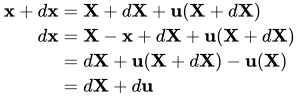
Betrachten wir nun einen materiellen Punkt benachbart mit Positionsvektor . In der deformierten Konfiguration hat dieses Teilchen eine neue Position gegeben durch den Positionsvektor . Angenommen, die Liniensegmente und das die Teilchen verbindet "/> . 19659181] P { displaystyle P , !} und sowohl in der unverformten als auch in der deformierten Konfiguration sehr klein, dann können wir sie als und . So aus Abbildung 2 haben wir
wobei ist der relative Verschiebungsvektor der den Verwandten darstellt Verschiebung von in Bezug auf in der verformten Konfiguration.
Für ein infinitesimales Element und unter der Annahme einer Kontinuität auf dem Verschiebungsfeld ist es möglich, eine Taylorreihen-Erweiterung um den Punkt wobei Ausdrücke höherer Ordnung vernachlässigt werden, um die Komponenten des relativen Verschiebungsvektors für das benachbarte Teilchen zu approximieren as
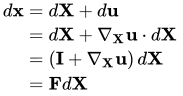
die vorhergehende Gleichung kann als geschrieben werden
X u [1945 d X = (19659959) I + X X 19659127] u ) d X = F d X { displaystyle { begin {align} d mathbf {x} & = d mathbf {X} + d mathbf {u} \ & = d mathbf {X} + nabla _ { mathbf {X}} mathbf {u} cdot d mathbf {X} \ & = left ( mathbf {I} + nabla _ { mathbf {X}} mathbf {u} right) d mathbf {X} \ & = mathbf {F} d mathbf {X} end {align}} , !}
Berechnungen, bei denen die zeitabhängige Verformung eines Körpers eine Rolle spielt, erfordern oft eine zeitliche Ableitung des Verformungsgradienten. Eine geometrisch konsistente Definition einer solchen Ableitung erfordert eine Exkursion in die -Differentialgeometrie [2] aber wir vermeiden diese Probleme in diesem Artikel.
Die zeitliche Ableitung von ist
wobei ist die Geschwindigkeit. Die Ableitung auf der rechten Seite repräsentiert einen Materialgeschwindigkeitsgradienten . Es ist üblich, das in einen räumlichen Gradienten umzuwandeln, d. H.
where is the spatial velocity gradient. If the spatial velocity gradient is constant, the above equation can be solved exactly to give
assuming at . There are several methods of computing the exponential above.
Related quantities often used in continuum mechanics are the rate of deformation tensor and the spin tensor defined, respectively, as:
The rate of deformation tensor gives the rate of stretching of line elements while the spin tensor indicates the rate of rotation or vorticity of the motion.
Transformation of a surface and volume element[edit]
To transform quantities that are defined with respect to areas in a deformed configuration to those relative to areas in a reference configuration, and vice versa, we use Nanson's relation, expressed as
where is an area of a region in the deformed configuration, is the same area in the reference configuration, and is the outward normal to the area element in the current configuration while is the outward normal in the reference configuration, is the deformation gradientand .
The corresponding formula for the transformation of the volume element is
To see how this formula is derived, we start with the oriented area elements
in the reference and current configurations:
The reference and current volumes of an element are
where .
Therefore,
or,
so,
So we get
or,
Polar decomposition of the deformation gradient tensor[edit]
Figure 3. Representation of the polar decomposition of the deformation gradient
The deformation gradient like any invertible second-order tensor, can be decomposed, using the polar decomposition theorem, into a product of two second-order tensors (Truesdell and Noll, 1965): an orthogonal tensor and a positive definite symmetric tensor, i.e.
where the tensor is a proper orthogonal tensori.e. and representing a rotation; the tensor is the right stretch tensor; and the left stretch tensor. The terms right and left means that they are to the right and left of the rotation tensor respectively. and are both positive definitei.e. and for all and symmetric tensorsi.e. and of second order.
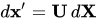
This decomposition implies that the deformation of a line element in the undeformed configuration onto in the deformed configuration, i.e. may be obtained either by first stretching the element by i.e. followed by a rotation i.e. ; or equivalently, by applying a rigid rotation first, i.e. followed later by a stretching i.e. (See Figure 3).
Due to the orthogonality of
so that and have the same eigenvalues or principal stretchesbut different eigenvectors or principal directions and respectively. The principal directions are related by
This polar decomposition, which is unique as is invertible with a positive determinant, is a corrolary of the singular-value decomposition.
Several rotation-independent deformation tensors are used in mechanics. In solid mechanics, the most popular of these are the right and left Cauchy–Green deformation tensors.
Since a pure rotation should not induce any strains in a deformable body, it is often convenient to use rotation-independent measures of deformation in continuum mechanics. As a rotation followed by its inverse rotation leads to no change () we can exclude the rotation by multiplying by its transpose.
In 1839, George Green introduced a deformation tensor known as the right Cauchy–Green deformation tensor or Green's deformation tensor defined as:[4][5]
Physically, the Cauchy–Green tensor gives us the square of local change in distances due to deformation, i.e.
where are stretch ratios for the unit fibers that are initially oriented along the eigenvector directions of the right (reference) stretch tensor (these are not generally aligned with the three axis of the coordinate systems).
The IUPAC recommends[5] that the inverse of the right Cauchy–Green deformation tensor (called the Cauchy tensor in that document), i. e., be called the Finger tensor. However, that nomenclature is not universally accepted in applied mechanics.
The left Cauchy–Green or Finger deformation tensor[edit]
Reversing the order of multiplication in the formula for the right Green–Cauchy deformation tensor leads to the left Cauchy–Green deformation tensor which is defined as:
The left Cauchy–Green deformation tensor is often called the Finger deformation tensornamed after Josef Finger (1894).[5][6][7]
Invariants of are also used in the expressions for strain energy density functions. The conventional invariants are defined as
where is the determinant of the deformation gradient.
For incompressible materials, a slightly different set of invariants is used:
Earlier in 1828,[8]Augustin Louis Cauchy introduced a deformation tensor defined as the inverse of the left Cauchy–Green deformation tensor, . This tensor has also been called the Piola tensor[5] and the Finger tensor[9] in the rheology and fluid dynamics literature.
If there are three distinct principal stretches the spectral decompositions of and is given by
Furthermore,
Observe that
Therefore, the uniqueness of the spectral decomposition also implies that . The left stretch () is also called the spatial stretch tensor while the right stretch () is called the material stretch tensor.
The effect of acting on is to stretch the vector by and to rotate it to the new orientation i.e.,
In a similar vein,
Examples
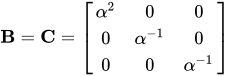
Uniaxial extension of an incompressible material
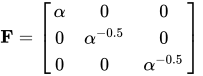
This is the case where a specimen is stretched in 1-direction with a stretch ratio of . If the volume remains constant, the contraction in the other two directions is such that or . Then:
Derivatives of the stretch with respect to the right Cauchy–Green deformation tensor are used to derive the stress-strain relations of many solids, particularly hyperelastic materials. These derivatives are
and follow from the observations that
Physical interpretation of deformation tensors[edit]
Let be a Cartesian coordinate system defined on the undeformed body and let be another system defined on the deformed body. Let a curve in the undeformed body be parametrized using . Its image in the deformed body is .
The undeformed length of the curve is given by
After deformation, the length becomes
Note that the right Cauchy–Green deformation tensor is defined as
Hence,
which indicates that changes in length are characterized by .
The concept of strain is used to evaluate how much a given displacement differs locally from a rigid body displacement.[1][10] One of such strains for large deformations is the Lagrangian finite strain tensoralso called the Green-Lagrangian strain tensor or Green – St-Venant strain tensordefined as
or as a function of the displacement gradient tensor
or
The Green-Lagrangian strain tensor is a measure of how much differs from .
The Eulerian-Almansi finite strain tensorreferenced to the deformed configuration, i.e. Eulerian description, is defined as
or as a function of the displacement gradients we have
Derivation of the Lagrangian and Eulerian finite strain tensors
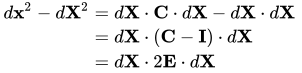
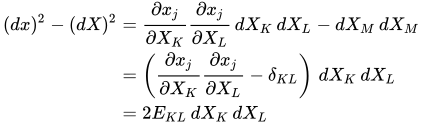
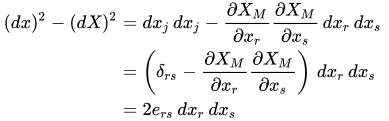
A measure of deformation is the difference between the squares of the differential line element in the undeformed configuration, and in the deformed configuration (Figure 2). Deformation has occurred if the difference is non zero, otherwise a rigid-body displacement has occurred. Thus we have,
In the Lagrangian description, using the material coordinates as the frame of reference, the linear transformation between the differential lines is
Then we have,
where are the components of the right Cauchy–Green deformation tensor. Then, replacing this equation into the first equation we have,
or
where are the components of a second-order tensor called the Green – St-Venant strain tensor or the Lagrangian finite strain tensor,
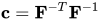
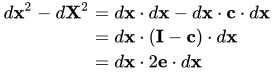
In the Eulerian description, using the spatial coordinates as the frame of reference, the linear transformation between the differential lines is
where are the components of the spatial deformation gradient tensor. Thus we have
where the second order tensor is called Cauchy's deformation tensor. Then we have,
or
where are the components of a second-order tensor called the Eulerian-Almansi finite strain tensor,
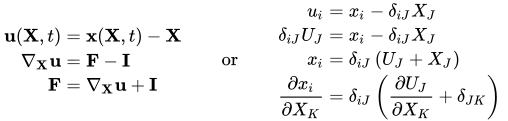
Both the Lagrangian and Eulerian finite strain tensors can be conveniently expressed in terms of the displacement gradient tensor. For the Lagrangian strain tensor, first we differentiate the displacement vector with respect to the material coordinates to obtain the material displacement gradient tensor
Replacing this equation into the expression for the Lagrangian finite strain tensor we have
or
Similarly, the Eulerian-Almansi finite strain tensor can be expressed as
Seth–Hill family of generalized strain tensors[edit]
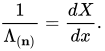
The stretch ratio is a measure of the extensional or normal strain of a differential line element, which can be defined at either the undeformed configuration or the deformed configuration.
The stretch ratio for the differential element (Figure) in the direction of the unit vector at the material point in the undeformed configuration, is defined as
where is the deformed magnitude of the differential element .
Similarly, the stretch ratio for the differential element (Figure), in the direction of the unit vector at the material point in the deformed configuration, is defined as
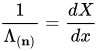
The normal strain in any direction can be expressed as a function of the stretch ratio,
This equation implies that the normal strain is zero, i.e. no deformation, when the stretch is equal to unity. Some materials, such as elastometers can sustain stretch ratios of 3 or 4 before they fail, whereas traditional engineering materials, such as concrete or steel, fail at much lower stretch ratios, perhaps of the order of 1.1 (reference?)
Physical interpretation of the finite strain tensor[edit]
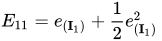
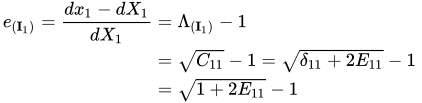
The diagonal components of the Lagrangian finite strain tensor are related to the normal strain, e.g.
where is the normal strain or engineering strain in the direction .
The off-diagonal components of the Lagrangian finite strain tensor are related to shear strain, e.g.
where is the change in the angle between two line elements that were originally perpendicular with directions and respectively.
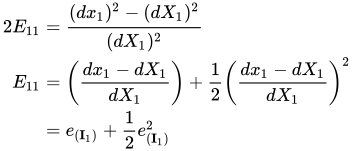
Under certain circumstances, i.e. small displacements and small displacement rates, the components of the Lagrangian finite strain tensor may be approximated by the components of the infinitesimal strain tensor
Derivation of the physical interpretation of the Lagrangian and Eulerian finite strain tensors
The stretch ratio for the differential element (Figure) in the direction of the unit vector at the material point in the undeformed configuration, is defined as
where is the deformed magnitude of the differential element .
Similarly, the stretch ratio for the differential element (Figure), in the direction of the unit vector at the material point in the deformed configuration, is defined as
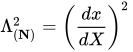
The square of the stretch ratio is defined as
Knowing that
we have
where and are unit vectors.
The normal strain or engineering strain in any direction can be expressed as a function of the stretch ratio,
Thus, the normal strain in the direction at the material point may be expressed in terms of the stretch ratio as
solving for we have
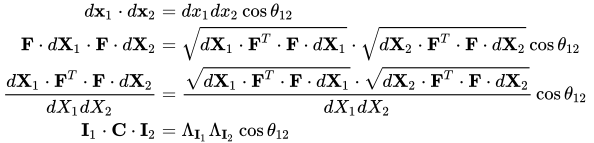
The shear strainor change in angle between two line elements and initially perpendicular, and oriented in the principal directions and respectivelly, can also be expressed as a function of the stretch ratio. From the dot product between the deformed lines and we have
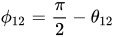
where is the angle between the lines and in the deformed configuration. Defining as the shear strain or reduction in the angle between two line elements that were originally perpendicular, we have
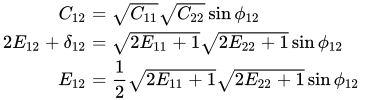
thus,
then
or
Deformation tensors in convected curvilinear coordinates[edit]
A representation of deformation tensors in curvilinear coordinates is useful for many problems in continuum mechanics such as nonlinear shell theories and large plastic deformations. Let denote the function by which a position vector in space is constructed from coordinates . The coordinates are said to be "convected" if they correspond to a one-to-one mapping to and from Lagrangian particles in a continuum body. If the coordinate grid is "painted" on the body in its initial configuration, then this grid will deform and flow with the motion of material to remain painted on the same material particles in the deformed configuration so that grid lines intersect at the same material particle in either configuration. The tangent vector to the deformed coordinate grid line curve at is given by
The three tangent vectors at form a local basis. These vectors are related the reciprocal basis vectors by
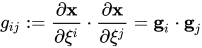
Let us define a second-order tensor field (also called the metric tensor) with components
To see how the Christoffel symbols are related to the Right Cauchy–Green deformation tensor let us similarly define two bases, the already mentioned one that is tangent to deformed grid lines and another that is tangent to the undeformed grid lines. Namely,
The deformation gradient in curvilinear coordinates[edit]
Using the definition of the gradient of a vector field in curvilinear coordinates, the deformation gradient can be written as
The right Cauchy–Green tensor in curvilinear coordinates[edit]
The right Cauchy–Green deformation tensor is given by
If we express in terms of components with respect to the basis {} we have
Therefore,
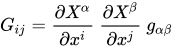
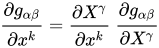
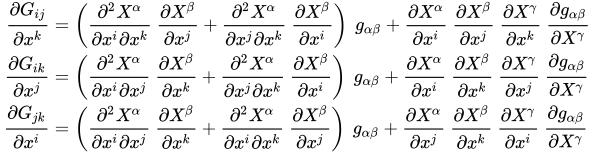
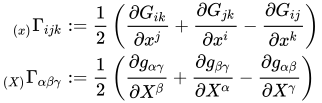
and the corresponding Christoffel symbol of the first kind may be written in the following form.
Some relations between deformation measures and Christoffel symbols[edit]
Let us consider a one-to-one mapping from to and let us assume that there exist two positive-definite, symmetric second-order tensor fields and that satisfy
Then,
Noting that
and we have
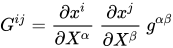
Define
Hence
Define
Then
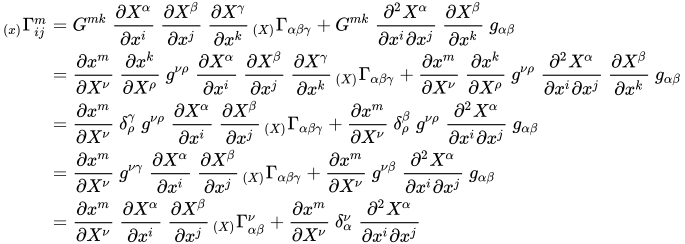
Define the Christoffel symbols of the second kind as
Then
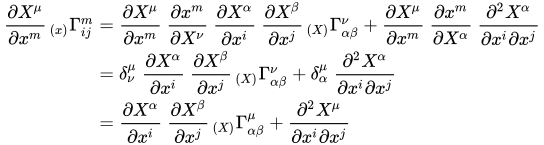
Therefore,
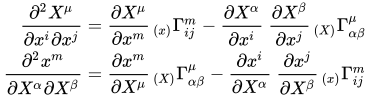
The invertibility of the mapping implies that
We can also formulate a similar result in terms of derivatives with respect to . Deshalb,
The problem of compatibility in continuum mechanics involves the determination of allowable single-valued continuous fields on bodies. These allowable conditions leave the body without unphysical gaps or overlaps after a deformation. Most such conditions apply to simply-connected bodies. Additional conditions are required for the internal boundaries of multiply connected bodies.
The necessary and sufficient conditions for the existence of a compatible field over a simply connected body are
Compatibility of the right Cauchy–Green deformation tensor[edit]
The necessary and sufficient conditions for the existence of a compatible field over a simply connected body are
We can show these are the mixed components of the Riemann–Christoffel curvature tensor. Therefore, the necessary conditions for -compatibility are that the Riemann–Christoffel curvature of the deformation is zero.
Compatibility of the left Cauchy–Green deformation tensor[edit]
No general sufficiency conditions are known for the left Cauchy–Green deformation tensor in three-dimensions. Compatibility conditions for two-dimensional fields have been found by Janet Blume.[17][18]
^A. Yavari, J.E. Marsden, and M. Ortiz, On spatial and material covariant balance laws in elasticity, Journal of Mathematical Physics, 47, 2006, 042903; pp. 1–53.
^Owens, Eduardo de Souza Neto, Djordje Peric, David (2008). Computational methods for plasticity : theory and applications. Chichester, West Sussex, UK: Wiley. p. 65. ISBN978-0-470-69452-7.
^The IUPAC recommends that this tensor be called the Cauchy strain tensor.
^Belytschko, Ted; Liu, Wing Kam; Moran, Brian (2000). Nonlinear Finite Elements for Continua and Structures (reprint with corrections, 2006 ed.). John Wiley & Sons Ltd. pp. 92–94. ISBN978-0-471-98773-4.
^Seth, B. R. (1962), "Generalized strain measure with applications to physical problems", IUTAM Symposium on Second Order Effects in Elasticity, Plasticity and Fluid Mechanics, Haifa, 1962.
^T.C. Doyle and J.L. Eriksen (1956). "Non-linear elasticity." Advances in Applied Mechanics 4, 53–115.
^Z.P. Bažant and L. Cedolin (1991). Stability of Structures. Elastic, Inelastic, Fracture and Damage Theories. Oxford Univ. Press, New York (2nd ed. Dover Publ., New York 2003; 3rd ed., World Scientific 2010).
^Z.P. Bažant (1998). "Easy-to-compute tensors with symmetric inverse approximating Hencky finite strain and its rate." Journal of Materials of Technology ASME120 (April), 131–136.
^Blume, J. A. (1989). "Compatibility conditions for a left Cauchy–Green strain field". J. Elasticity. 21: 271–308. doi:10.1007/BF00045780.

























![{ mathbf F} ({ mathbf X}, t) = F _ {{jK}} { mathbf} _ {j} otimes { mathbf I} _ {K} , ! [!] 19659015] bezieht sich sowohl auf die Referenz- als auch auf die aktuelle Konfiguration, wie aus den Einheitsvektoren <span class=](https://wikimedia.org/api/rest_v1/media/math/render/svg/0e1fb7322aa69fb5c635f8259fb70e72c49aa4dd) und
und 


 ist der räumliche Deformationsgradiententensor . Dann, durch den Theorem




 in der neuen Konfiguration angezeigt gegeben durch die Vektorposition








![{ dot {{ mathbf {F}}}} = { frac { partial { mathbf {F}}} { partial t}} = { frac { partielle} { partielle t}} left [{frac {partial {mathbf {x}}({mathbf {X}},t)}{partial {mathbf {X}}}}right] = { frac { partielle} { partielle { mathbf {X}}}} left [{frac {partial {mathbf {x}}({mathbf {X}},t)}{partial t}}right] = { frac { partial} { partielle { mathbf {X}}}} left [{mathbf {V}}({mathbf {X}},t)right]](https://wikimedia.org/api/rest_v1/media/math/render/svg/f2666606a9db3c727de1e94fa372b590683f72c0)

![{displaystyle {dot { mathbf {F} }}={frac {partial }{partial mathbf {X} }}left[mathbf {V} (mathbf {X} ,t)right]={frac {partial }{partial mathbf {x} }}left [mathbf {V} (mathbf {X} ,t)right]cdot {frac {partial mathbf {x} (mathbf {X } ,t)}{partial mathbf {X} }}={boldsymbol {l}}cdot mathbf {F} }](https://wikimedia.org/api/rest_v1/media/math/render/svg/7eceea87251a369ad9a9d84fe6e37b32801a6241)































![{begin{aligned}I_{1}^{C}&:={text{tr}}({mathbf {C}})=C_{{II}}=lambda _{1}^{2}+lambda _{2}^{2}+lambda _{3}^{2}\I_{2}^{C}&:={tfrac {1}{2}}left[({text{tr}}~{mathbf {C}})^{2}-{text{tr}}({mathbf {C}}^{2})right]={tfrac {1}{2}}left[(C_{{JJ}})^{2}-C_{{IK}}C_{{KI}}right]=lambda _{1}^{2}lambda _{2}^{2}+lambda _{2}^{2}lambda _{3}^{2}+lambda _{3}^{2}lambda _{1}^{2}\I_{3}^{C}&:=det({mathbf {C}})=lambda _{1}^{2}lambda _{2}^{2}lambda _{3}^{2}.end{aligned}},!](https://wikimedia.org/api/rest_v1/media/math/render/svg/3704e68e2c34682fc7ee876f06e3c89f4197311b)





![{begin{aligned}I_{1}&:={text{tr}}({mathbf {B}})=B_{{ii}}=lambda _{1}^{2}+lambda _{2}^{2}+lambda _{3}^{2}\I_{2}&:={tfrac {1}{2}}left[({text{tr}}~{mathbf {B}})^{2}-{text{tr}}({mathbf {B}}^{2})right]={tfrac {1}{2}}left(B_{{ii}}^{2}-B_{{jk}}B_{{kj}}right)=lambda _{1}^{2}lambda _{2}^{2}+lambda _{2}^{2}lambda _{3}^{2}+lambda _{3}^{2}lambda _{1}^{2}\I_{3}&:=det {mathbf {B}}=J^{2}=lambda _{1}^{2}lambda _{2}^{2}lambda _{3}^{2}end{aligned}},!](https://wikimedia.org/api/rest_v1/media/math/render/svg/5a3d7bf82330d0d670c9e102fc5cfa569abfbc69)














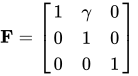
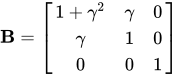
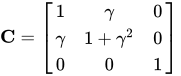
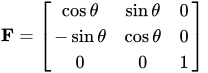
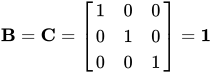




![sin [0,1]](https://wikimedia.org/api/rest_v1/media/math/render/svg/aff1a54fbbee4a2677039524a5139e952fa86eb9)


![{begin{aligned}l_{x}&=int _{0}^{1}left|{cfrac {d{mathbf {x}}}{ds}}right|~ds=int _{0}^{1}{sqrt {{cfrac {d{mathbf {x}}}{ds}}cdot {cfrac {d{mathbf {x}}}{ds}}}}~ds=int _{0}^{1}{sqrt {left({cfrac {d{mathbf {x}}}{d{mathbf {X}}}}cdot {cfrac {d{mathbf {X}}}{ds}}right)cdot left({cfrac {d{mathbf {x}}}{d{mathbf {X}}}}cdot {cfrac {d{mathbf {X}}}{ds}}right)}}~ds\&=int _{0}^{1}{sqrt {{cfrac {d{mathbf {X}}}{ds}}cdot left[left({cfrac {d{mathbf {x}}}{d{mathbf {X}}}}right)^{T}cdot {cfrac {d{mathbf {x}}}{d{mathbf {X}}}}right]cdot {cfrac {d{mathbf {X}}}{ds}}}}~dsend{aligned}}](https://wikimedia.org/api/rest_v1/media/math/render/svg/dd1b639bab0e25d96cf46894973e1d2693800d94)
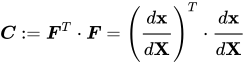
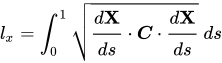


![{mathbf E}={frac {1}{2}}left[(nabla _{{{mathbf X}}}{mathbf u})^{T}+nabla _{{{mathbf X}}}{mathbf u}+(nabla _{{{mathbf X}}}{mathbf u})^{T}cdot nabla _{{{mathbf X}}}{mathbf u}right],!](https://wikimedia.org/api/rest_v1/media/math/render/svg/cb57038f53e8acd75c977dd33dc650dd27913b2c)


















![{begin{aligned}{mathbf E}&={frac {1}{2}}left({mathbf F}^{T}{mathbf F}-{mathbf I}right)\&={frac {1}{2}}left[left{(nabla _{{{mathbf X}}}{mathbf u})^{T}+{mathbf I}right}left(nabla _{{{mathbf X}}}{mathbf u}+{mathbf I}right)-{mathbf I}right]\&={frac {1}{2}}left[(nabla _{{{mathbf X}}}{mathbf u})^{T}+nabla _{{{mathbf X}}}{mathbf u}+(nabla _{{{mathbf X}}}{mathbf u})^{T}cdot nabla _{{{mathbf X}}}{mathbf u}right]\end{aligned}},!](https://wikimedia.org/api/rest_v1/media/math/render/svg/26c63bb3f2bec5cafe7a362ed4734da711ddb0fb)
![{begin{aligned}E_{{KL}}&={frac {1}{2}}left({frac {partial x_{j}}{partial X_{K}}}{frac {partial x_{j}}{partial X_{L}}}-delta _{{KL}}right)\&={frac {1}{2}}left[delta _{{jM}}left({frac {partial U_{M}}{partial X_{K}}}+delta _{{MK}}right)delta _{{jN}}left({frac {partial U_{N}}{partial X_{L}}}+delta _{{NL}}right)-delta _{{KL}}right]\&={frac {1}{2}}left[delta _{{MN}}left({frac {partial U_{M}}{partial X_{K}}}+delta _{{MK}}right)left({frac {partial U_{N}}{partial X_{L}}}+delta _{{NL}}right)-delta _{{KL}}right]\&={frac {1}{2}}left[left({frac {partial U_{M}}{partial X_{K}}}+delta _{{MK}}right)left({frac {partial U_{M}}{partial X_{L}}}+delta _{{ML}}right)-delta _{{KL}}right]\&={frac {1}{2}}left({frac {partial U_{K}}{partial X_{L}}}+{frac {partial U_{L}}{partial X_{K}}}+{frac {partial U_{M}}{partial X_{K}}}{frac {partial U_{M}}{partial X_{L}}}right)end{aligned}},!](https://wikimedia.org/api/rest_v1/media/math/render/svg/f2191e97fce373db79be4298a1a6769b1ceb97ce)
![{mathbf E}_{{(m)}}={frac {1}{2m}}({mathbf U}^{{2m}}-{mathbf I})={frac {1}{2m}}left[{mathbf {C}}^{{m}}-{mathbf {I}}right],!](https://wikimedia.org/api/rest_v1/media/math/render/svg/b56dbd88d4681c3732c87a09d3c96be97d04d651)

![{begin{aligned}{mathbf E}_{{(1)}}&={frac {1}{2}}({mathbf U}^{{2}}-{mathbf I})={frac {1}{2}}({mathbf {C}}-{mathbf {I}})&qquad {text{Green-Lagrangian strain tensor}}\{mathbf E}_{{(1/2)}}&=({mathbf U}-{mathbf I})={mathbf {C}}^{{1/2}}-{mathbf {I}}&qquad {text{Biot strain tensor}}\{mathbf E}_{{(0)}}&=ln {mathbf U}={frac {1}{2}},ln {mathbf {C}}&qquad {text{Logarithmic strain, Natural strain, True strain, or Hencky strain}}\{mathbf {E}}_{{(-1)}}&={frac {1}{2}}left[{mathbf {I}}-{mathbf {U}}^{{-2}}right]&qquad {text{Almansi strain}}end{aligned}},!](https://wikimedia.org/api/rest_v1/media/math/render/svg/02986daeab9d6df911daf7c76fb84647fb5e9024)


























![Gamma _{{ijk}}={tfrac {1}{2}}[({mathbf {g}}_{i}cdot {mathbf {g}}_{k})_{{,j}}+({mathbf {g}}_{j}cdot {mathbf {g}}_{k})_{{,i}}-({mathbf {g}}_{i}cdot {mathbf {g}}_{j})_{{,k}}]](https://wikimedia.org/api/rest_v1/media/math/render/svg/6c84f52a8b94bf81096fd54ad218ac8c8a794593)






![Gamma _{{ijk}}={tfrac {1}{2}}[C_{{ik,j}}+C_{{jk,i}}-C_{{ij,k}}]={tfrac {1}{2}}[({mathbf {G}}_{i}cdot {boldsymbol {C}}cdot {mathbf {G}}_{k})_{{,j}}+({mathbf {G}}_{j}cdot {boldsymbol {C}}cdot {mathbf {G}}_{k})_{{,i}}-({mathbf {G}}_{i}cdot {boldsymbol {C}}cdot {mathbf {G}}_{j})_{{,k}}]](https://wikimedia.org/api/rest_v1/media/math/render/svg/626053366fba8dffc9ee988c8728f9b476cee63a)






![[G^{{ij}}]=[G_{{ij}}]^{{-1}}~;~~[g^{{alpha beta }}]=[g_{{alpha beta }}]^{{-1}}](https://wikimedia.org/api/rest_v1/media/math/render/svg/b6168f5195b650daf063a1dd26b314242926f774)





![R_{{alpha beta rho }}^{gamma }:={frac {partial }{partial X^{rho }}}[,_{{(X)}}Gamma _{{alpha beta }}^{gamma }]-{frac {partial }{partial X^{beta }}}[,_{{(X)}}Gamma _{{alpha rho }}^{gamma }]+,_{{(X)}}Gamma _{{mu rho }}^{gamma },_{{(X)}}Gamma _{{alpha beta }}^{mu }-,_{{(X)}}Gamma _{{mu beta }}^{gamma },_{{(X)}}Gamma _{{alpha rho }}^{mu }=0](https://wikimedia.org/api/rest_v1/media/math/render/svg/29e1d54640569dc6ab58c0fca0c0ab634aef2180)


No comments:
Post a Comment